7.27.2005

ABANDONING NEIGHBORHOOD RETAIL STRIPS: One of the many undiscussed issues surrounding the Steelyard Commons project is the shift it signals in City Hall's neighborhood commercial development policy. In hitching its policy to a megabox "power center" featuring a Wal-Mart SuperCenter, the Campbell Administration is abandoning a twenty-year strategic commitment to neighborhood retail strips -- nodes of small and mid-sized stores serving households within a mile or two.

This Steelyard Commons marketing site, caught Tuesday by Jeff Hess, makes the whole thing pretty clear. SYC is a "regional power center serving an untapped trade area with no competition... This development will create a new regional trade area in a previously underserved and impenetrable market."

What's this "untapped trade area with no competition"... this "impenetrable market"? For the answer, take a look at this city neighborhood map with a three-mile circle drawn around SYC, represented, naturally, by a frownie-face.
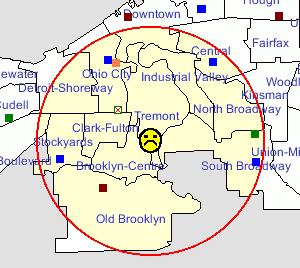


You can see that this circle includes all or most of nine neighborhoods (not counting downtown and the Industrial Valley). Each of these neighborhoods (Old Brooklyn, Brooklyn Centre, Stockyards, Detroit-Shoreway, Ohio City, Clark-Fulton, Central, North Broadway and South Broadway) has its own community development corporation, or shares a CDC with the area next door. Each of these CDCs has a longstanding commercial development program focussed on preserving and expanding local shopping opportunities in one or more retail nodes. In most of these programs, neighborhood food markets -- i.e. small to mid-sized supermarkets -- play an essential role as local amenities and anchors for other local shopping.

The little colored squares on the map are those food markets. Blue squares are Dave's Supermarkets, green squares are Tops Markets, brown squares are independents. The orange square in Ohio City is the West Side Market. I haven't included discount groceries like Aldi's, but Brooklyn Centre, Detroit-Shoreway and Broadway have those, as well. The square with the "x" in Clark-Fulton is the recently closed Tops on Clark Avenue -- which would be the subject of a neighborhood crusade right now, if it wasn't for the Wal-Mart SuperCenter looming just over the hill. Where you see a colored square, there is almost certainly a larger "local retail" node that's been nursed, marketed and invested in -- by the local CDC, by the City, by the foundations through Neighborhood Progress -- for ten, fifteen or even twenty years.

The business plan of Steelyard Commons is to pull lots of the local customers away from neighborhood retail nodes, effectively wiping them out. That's not scare talk... it's a simple statement of obvious fact. SYC's big anchor is Wal-Mart, and Wal-Mart wouldn't play unless it could sell food. The principal market area for a SuperCenter is generally described as two miles around for food, and five miles around for other goods (that's why so many small cities are seeing one built at each end of town). Who are the "untapped, impenetrable" customers for Wal-Mart in that magic circle? They're the people now shopping at Dave's, the Bi-Rite on Fulton, Gillombardo's Tops on Broadway -- the local shoppers who make those local retail strips sustainable.

By supporting -- pushing, celebrating -- this SYC/Wal-Mart business plan, the Campbell Administration is abandoning the City's twenty-year commitment to food-anchored neighborhood shopping districts in these and (eventually) other neighborhoods. The Mayor will hotly deny this, of course, but there's really no other rational interpretation that fits the facts.

The circle on the map is a retail blast zone, and City Hall is escorting Wal-Mart to the launch button.

Why is this not a fighting issue for even one of Campbell's opponents? There you have the great mystery of this election year.

7.26.2005

IT'S A SMALL, SMALL WORLD-CLASS: Remember the "world-class steel heritage museum" that was going to be part of Steelyard Commons? Turns out it's going to have a whopping six hundred square feet of display space. It's not clear whether that includes the bathrooms. Jeff Hess has appropriate comments.
VIRTUE IS ITS OWN AWARD: Congratulations to Brewed Fresh Daily for winning the Free Times "Best Cleveland Blog" Freebie Award. (No link, the FT website's down for maintenance.)

The squib says Cleveland Diary was a "runner-up" for the award. That would be a distant runner-up, running way back in a crowded pack. But it's nice to hear anyway. Thanks, FT.
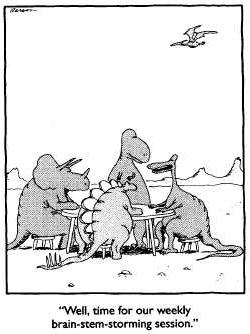
TUESDAY BRAIN BLOGGING: Click on the brain in the jar.

7.25.2005

NEW COMMENT POLICY: As of two minutes ago, it is this site's policy to delete any comments that are both a) anonymous, and b) irrelevant to the post they're attached to. Comments which fall in only one of these categories will be dealt with on a case-by-case basis.
GRAY AND WHITE, PART 2: Anonymous commenter "Mike" says:
it was common knowledge in the law enforcement community that white was forced to step down from office and pledge to never run for public office again in order to escape an indictment from the feds. where have you guys been?
I wouldn't take this seriously from an anonymous source, except that it squares with what I was told by a knowledgeable person that I know very well. "Mike" could just have been feeding that person's words (quoted at the end of the post) back to me, of course. One thing's for sure: If Mayor White cut a deal with the Federal prosecutor, it sure isn't "common knowledge" in the community of ordinary, oblivious citizens who read the newspaper.

Which might be because it isn't true, of course.

Does any of this matter any more? Yes. Mike White remains a major influence in Cleveland politics. People from his close staff and Cabinet occupy positions of public and community trust. Just months ago (i.e. until Frank Jackson announced) there was media speculation about the possibility of White running for mayor again. What happened at City Hall barely four years ago is not old news... especially if it hasn't been in the news at all.

(It is possibly relevant that in 2001 and 2002 the U.S. Attorney for Northern Ohio was not Republican Greg White -- Bush's 2000 Northeast Ohio campaign co-chair, appointed to the job in 2003 -- but Emily Sweeney, appointed by Bill Clinton.)

MY TINFOIL HAT DEPARTMENT: I heard my first grassroots conspiracy theory about the Nate Gray stories on Friday. A friend who works at an East Side community agency told me her colleague's consensus is that the PD held back the story until last week because they were waiting for a mayoral candidate they liked better than Campbell... but seeing none, they've decided to support Campbell, so they released the anti-White stuff to make her look good by comparison.

I don't think this is a very satisfying theory (Why would Clifton have humiliated himself for two weeks? Where does Scene fit in?), but it's okay as a game-opener. Here's one I like better, which should be popular among my fellow Democrats:

U.S. Attorney Greg White and PD publisher Alex Machaskee are both partisan Republicans and former Northeast Ohio Bush campaign leaders. Seeing that Coingate and its many outgrowths are wreaking havoc on their friends, they cook up the release of the Gray documents as a diversionary Democratic scandal. But they need extreme deniability. So a defense lawyer is somehow enlisted to show the documents to the PD... the PD lets it be known that it has something momentous but fears prosecution, creating a major brouhaha... Scene is given a peek, giving the PD "no choice" but to publish... prosecutor White waxes indignant and calls for an investigation. Voila! Coingate is no longer the scandal du jour in Cleveland.

Like that one? I made it up myself. That is, I think I did...

7.24.2005

PASTY, WHITE OLD GEEKS AND OTHER ODDITIES: PD City Hall reporter Olivera Perkins has been working on this story for at least a month. Isn't that unbelievable?

The last actual event mentioned in the story (the "recent house party") took place almost three weeks ago, on July 6. The "recent" meeting of bloggers at Metro Joe's was a week before that (I was there). If Perkins did any follow-up interviews from those two events -- other than the obligatory phone call with the AFL-CIO's John Ryan -- it sure doesn't show in the story.

The two-week lapse between Perkins' note-taking and actual writing may explain why, in more than twenty column inches of atmosphere and "color", she was unable to quote two consecutive sentences from anyone but Ryan. (He got three really short ones.) And also why she failed to present a coherent account, in or out of quotes, of even one of the reasons people gave her for opposing the Steelyards Wal-Mart.

Like, for example, why people like me insist that Steelyard Commons is in line for a hefty public subsidy, contrary to what City Hall and her paper have been saying. Perkins writes:
There was talk about stalling the project because the Steelyard developer is getting federal tax credits through a program for development in low-income areas. Those credits, the bloggers reasoned, amount to a public subsidy, allowing them to push for a public hearing.
The bloggers reasoned? Is there some imaginable way that $32 million in financing, subsidized with Federal tax credits arranged through the Port of Cleveland, would not "amount to a public subsidy"? More to the point, is there some imaginable good reason why a reporter, hearing citizens describe an alleged government subsidy of a supposedly unsubsidized project, would fail to call up the Port to ask: a) whether the citizens are correct; and b) if so, what Port officials have to say about it?

But if Perkins made that call, she's not telling. She's content to note that we bloggers were "excited". (I guess she could tell from the way we rubbed our pasty white hands together.) So who cares if we were right?

I have to admit, I really expected better from Perkins. Live and learn.

P.S. Twelve more days have passed, and the PD still has not written about the Secret Wal-Mart Subsidy... either the $32 million in New Markets Tax Credit financing itself, or the fact that it contradicts repeated claims that SYC is an unsubsidized project, or the bizarre attempt by Port officials to evade public scrutiny through the "private" Northeast Ohio Development Fund. Sorry, but I don't think the "excited bloggers" passage above changes anything. Still counting.

7.23.2005

NOW HERE'S A NEIGHBORHOOD PLANNING TOOL!

My block as a Google Hybrid Map. (Thank you, Zonk at Slashdot.)

7.22.2005

JAIL... OR HELL FOREVER? Okay, now we find out whether the PD's lawyers were right to be so worried about somebody going to jail.

From the AP:
A federal prosecutor asked a judge Thursday to determine how three documents under seal were released to newspapers reporting on a public corruption investigation involving the city's former mayor.

U.S. Attorney Gregory A. White filed the motion the same day The Plain Dealer reported that former Mayor Michael R. White was a target of a federal investigation that began three years ago and that led to the indictment of one of White's friends. The weekly newspaper Scene published a similar report Wednesday.

The prosecutor asked U.S. District Judge James S. Gwin to hold a hearing to determine who disclosed the documents. There was no immediate word on whether Gwin would hold a hearing.

Doug Clifton, The Plain Dealer's editor, said he had not seen the motion and declined further comment. Pete Kotz, Scene's editor, said he intends to protect the identity of the person who gave him the documents.

"If you rat a guy you're going to go to hell forever," Kotz said. "I'm not going to rat anybody."

... The Plain Dealer reported that a lawyer it didn't identify allowed the newspaper to review the memo.

... In the motion, the prosecutor said an intentional violation of the court order sealing the documents could constitute, at minimum, contempt of court.
Several of my friends in the NEO blogging network have attacked Clifton mercilessly for withholding this (and maybe another) story from print for fear of legal repercussions. Now that the story's been out for two days, nobody has posted much about it (just this from Jeff, and this from Right Angle Blog).

What do you think, folks? Should someone should go to jail... or to hell? Will there be a Bloggers Legal Defense Fund for Kotz, Tobin and Clifton?

Just asking.

Update: democracyguy responds.

7.21.2005

GRAY AND WHITE: So Nate Gray's other shoe has finally dropped on Mike White. Apparently Pete Kotz's one-day scoop in Scene really was one of (or part of) Doug Clifton's suppressed PD stories, because there it was on the PD's front page this morning.

Yes, it turns out it was material under court seal in a Federal case. And yes, it was the Nate Gray case. You read it here first.

But most people read it in Scene first, so the scalp (along with the chance to print a picture of Mike White in a target on your front page) goes to Kotz and Scene. Now we'll find out if the PD has anything else.

In reading both the Scene and PD stories (and if you haven't, you should), here are some critical things to keep in mind:

1) As mayor, Mike White was a total micro-manager. I mean total. When my wife worked as a nurse for the City Health Department in 1995, setting up neighborhood immunization clinics, every single flyer she produced (not just the template) had to be cleared by the Mayor's Office. Nobody made a move in White's City Hall that White didn't know about.

2) Nate Gray's reputation as a fixer was common knowledge in and around City Hall. I personally heard it joked about in casual conversation with a Cabinet member in 1998... and believe me, I was way outside anybody's inner circle.

3) The Scene story says the FBI found the first big cash deposits into Gray's bank account early in White's first term.

4) White and his wife, a former Lakewood City Council member with a very good job running a big East Side social service agency, both abruptly decided in 2001 to give up the urban rat race for a life of alpaca ranching in Newcomerstown. "Abruptly" may only be the way it appears to us, of course; they might have been planning the change for years. But 2001 also seems to be when the FBI interviews and phone intercepts got hot and heavy.

Several months ago, a usually well-informed person told me that getting out of town and out of politics was part of a deal the former mayor made with the Federal prosecutor. Nothing in yesterday and today's stories contradicts this assertion.

7.20.2005

BEFORE THE DOG EATS IT...

Homework from tonight's Cleveland Weblogger Meetup is to list the blogs we always check out in any two-day period. Here's my current list, in no particular order:
BFD
Eschaton
MaxSpeak
Hullabaloo
Cuyahoga County Planning Commission
democracy guy
MaryBeth Matthews
havecoffeewillwrite
Hypothetically Speaking
Lawrence Lessig
Muniwireless
Red Wheelbarrow
NEO Babble
There's a longer list of "Blogs I probably check out in any two-day period, but not absolutely always." Yes, of course you're on it.
BETTER QUESTIONS: George at Brewed Fresh Daily seldom meets a podcast he doesn't like, but he found one posted at Robert Triozzi's mayoral campaign blog.

George asks:
Can we have someone ask better questions? If someone going to interview mayoral candidates, can we please ask something beside “How do you rank Cleveland in safety and what are you hearing from the people”?
George, are we the someone we are waiting for? I certainly have questions I'd like to pose to all the candidates and post their answers. I bet you do, too. And I bet that we, along with our friends, could create an environment in which the campaigns would feel obliged to respond to those questions.

Think we could organize an ongoing no-holds-barred candidates' debate in blogspace?

7.19.2005

MAYORAL MIGRATION: It's been a tough election year for Cleveland realtors. Tom Coyne decided that his heart is still back in Brook Park. Ray Pierce packed up all that visionary leadership and headed for North Carolina, where they understand him. Jim Rokakis and Dan Moore both decided to stick with their suburban addresses. Talk about a brain drain! For a while there, it looked like we might have a mayoral election without selling a single house.

But luckily, David Lynch has decided this is his year to save Cleveland. So as of December, he's from Collinwood. As the Republican lawyer and onetime Euclid mayor told the Sun News:
"I moved there at the end of December of last year," Lynch said of his Grovewood Avenue home. "I didn't know if I was going to run for sure when I moved there, but I've since decided that I will."
And aren't we lucky that he did! In his seven months living among us, Lynch has learned that "there is a dire need to improve Cleveland Public Schools, reduce the crime rate and revise tax structures to make it easier to do business in Cleveland." And there's more, courtesy of Right Angle Blog:
[H]e would like to see a regional program established wherein the various communities in Cuyahoga would share in the tax revenues brought in by businesses so that one city isn't competing against another for jobs. Lynch also appropriated Voinovich's line for city government of "Harder and smarter" by recognizing that citizens are basically customers and government must be more responsive.

The lit piece Lynch had available said he was for casinos, but he acknowledged they aren't the panacea. He's also for lakeshore development and a new convention center. He is against red light cameras...

... [H]e'd like to bring the Rock 'n' Roll Hall of Fame ceremonies to Cleveland, and he'd also like to see Cleveland make a bid for the Summer Olympics.

...Lynch did shy away from talking about the upcoming school levy... It also sounded as if he was going to be signing off/agreeing to Dan T. Moore's Cleveland Action Plan.
Wow, that's exciting stuff. This is clearly a man of deep insight and bold, original thinking, unafraid to take on conventional wisdom and buck the elites. Definitely cut out to be a city-saver. They sure raise'em tough in... Euclid? or Cleveland Heights? Wherever he's from.

Not all our suburban "city leaders" are this superfluous. Rokakis moved to Rocky River when he ascended from City Hall to the County Building, but he's still a serious Cleveland politician with one of the city's biggest voting bases. Rev. Marvin McMickle, a Shaker resident who used to be "mentioned" for Cleveland mayor all the time, spends his days pastoring a church at 89th and Cedar. Dan Moore's "Action Cleveland" program is a mess -- in some respects an elitist, condescending mess -- but he's a smart guy who's built and operated real businesses in a Cleveland neighborhood for twenty years, so you have to take his views about the city seriously.

But David Lynch, parachuting in from Euclid to save us? Is this the best the party of Perk and Voinovich can come up with?

Well, at least we sold Lynch a house. But I hope he kept his realtor's card. Something tells me he'll be looking for it in November, when it's time to follow the crop to another town.
TUESDAY BRAIN BLOGGING: Anyone we know?

7.14.2005

TIME FOR A POWER STRUGGLE IN CLEVELAND

I haven't written about Cleveland electric rates since last Fall. But I think the time has come.

Three or four of you might remember (well, I'm about to remind you, okay?) this post from last November, in which I rejoiced that my Cleveland Public Power bill had actually shrunk a little. That was the good news; the bad news was that the relief was a) probably temporary and b) wouldn't really change CPP's status as one of Ohio's most expensive electric utilities, right up there with its "competitor" First Energy.

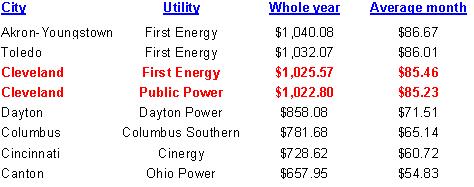
Unfortunately, I was right on both counts. I just went through my last twelve monthly CPP bills, along with the PUCO's "Utility Rate Surveys" for the same months. Here's what electricity cost a household that used 750 kilowatt-hours per month, during the year that ended with May 2005:


As I've pointed out before, all these utilities are selling the same product to the same kinds of customers for the same end uses. Other than CPP, they're all large investor-owned corporations, all with unions, all operating under the same laws and PUCO regulation. There are dozens of smaller utilities across the state, mostly run by cities and villages like CPP, but all selling power much cheaper.

The extra electricity cost of living in Cleveland rather than Columbus or Cincinnati is as high as $20-25 a month for households with normal usage. If this was a cable bill increase you would hear our screams in Chillicothe. If it was a school levy... well, we'll soon see. If the extra cost to businesses was a tax, the Greater Cleveland Partnership would be up in arms. (The PUCO Rate Survey says that the electric cost differential in June between Cleveland and Canton, for a commercial customer using 300,000 kwh, was about $18,000 a month!)

So why do Cleveland voters tolerate this? Why is CPP, once the "third rail of Cleveland politics", now conducting its publicly owned business in a virtual cone of silence, as far as candidates for Mayor and City Council are concerned?

The Mayor and City Council are the CEO and Board of Cleveland Public Power. So here's the question I want to hear answered by any City candidate who wants my vote this year: If you're elected or re-elected, what's your plan to lower my CPP bills by at least 20% during your next four years in office?

7.13.2005

ROLDO ON THE PD'S LANGUISHING STORIES: In his new column at Cool Cleveland, Roldo Bartimole explains how Clifton's tale of two lost stories got into Editor and Publisher, and adds some thoughts about the Nate Gray scenario.
REDFERN RESPONDS: I just noticed that Ohio House Democratic Leader Chris Redfern posted a comment two days ago on my last Third Frontier entry. Here's his comment in its entirety:
Now, now. Let's get that brain stem functioning again... Here's the position I and my colleagues hold on this whole Third Frontier Issue.

We believe that this issue is poorly constructed and gives Ohioans living outside of the 3 C's little reason to vote for it. That being presumed, how on earth does the Governor think he gets this thing passed. All the warm fuzzy feelings one may get about the implementation of this issue don't matter if it doesn't pass in November.

Here's what we suggested and will continue to push: Decouple the Third Frontier from the roads and bridges money and let the two issues stand on their own merits. Barring that, than the Third Frontier Board and the advisory board membership must be changed to reflect the diversity (geographically) of this state. Additionally, all projects funded with public dollars that include construction workers and skilled labor must be paid the prevailing wage. The Third Frontier Issue must not be affected in such a way by the legislature that would hinder the ability of scientists and innovators (ie stem cell research bans), minority Ohioans must have the opportunity to compete fairly for Third Frontier monies. And finally, the campaign itself must not be run by politicians looking to line their own pockets through campaign contributions and hefty contracts.

If Bob Taft wants Democratic votes, he should agree with our concerns.

It's pretty simple, even for someone who needs a functioning brain stem.

Chris Redfern
House Democratic Leader
I appreciate Rep. Redfern's taking the time to respond and his good humor about the "brain stem" theme. I understand his concerns about the GOP 3F proposal (stem cell, prevailing wage, minority access, not mucking up the highway bond question, even geography) as far as they go.

But I'm sorry he didn't speak to the actual issue that was raised here: If we think the Taft/Trakas Third Frontier is a dubious proposition, where are the serious, creative Democratic proposals to promote new business growth, better jobs and equitable participation in Ohio's new economy -- or the old economy, for that matter? Are casinos and Wal-Marts the best we can come up with?

Rep. Redfern (and other Statehouse Democrats), can we talk about this, here at Cleveland Diary or anywhere else you want? It may not be simple, but I don't think it's too much for any of our brain stems to handle.
DISPATCHES FROM THE SWAMP: Hypothetically Speaking keeps churning out lots of informative stuff from the Columbus/Statehouse scandal front. Here are two items he posted yesterday on the Ohio GOP's cascading legal problems -- on Tim Hagan's 2002 campaign kickback suit against Taft and company, which actually seems to be heading for a courtroom, somewhere; and on the Governor's attempts to avoid surrendering documents and possibly being deposed about the BWC/Coingate mess.

People Have the Power also posted a scandal roundup.

For those like SusanG at Daily Kos, who fears that "the rat's nest of Ohio politics [is] being left uninvestigated for fear of jail time" because the Plain Dealer's suppressed stories must be connected to Coingate, there's good news: All the litigation described above is taking place in state and county courts, where Ohio's very strong reporter shield laws apply. Here's Ohio Revised Code Section 2739.12:
No person engaged in the work of, or connected with, or employed by any newspaper or any press association for the purpose of gathering, procuring, compiling, editing, disseminating, or publishing news shall be required to disclose the source of any information procured or obtained by such person in the course of his employment, in any legal proceeding, trial, or investigation before any court, grand jury, petit jury, or any officer thereof, before the presiding officer of any tribunal, or his agent, or before any commission, department, division, or bureau of this state, or before any county or municipal body, officer or committee thereof.
There's a similar section for broadcast reporters. Doesn't leave much room for doubt, does it? If the PD's secret documents concern the operation of a state agency like the BWC, there's very little danger of a reporter or editor getting jail time for protecting their source.

So assuming Doug Clifton is quoting the PD's lawyers accurately, those documents are about something else -- something in Federal jurisdiction. Like, possibly, the Nate Gray investigation.

Update: "Chief justice disqualifies entire Cuyahoga County court". Yes, you read that right. It's the Hagan vs. Taft case mentioned above. Read it and rub your eyes in wonder. (via De Magno Opere)

7.12.2005

THE OTHER STORY DOUG CLIFTON ISN'T TELLING: THE SECRET WAL-MART SUBSIDY

It's now been 178 days since the Plain Dealer last mentioned the $32 million in Federal tax credit financing planned for the Steelyard Commons project. It's been 54 days since the paper editorialized that Steelyard developer Mitch Schneider "asked for no subsidies".

It's been 33 days since the Sun News revealed that the secret subsidy plan is still alive and well.

It's been 24 days since this weblog quoted a Port official saying that the Port-created entity which controls the public subsidy, the Northeast Ohio Development Fund, is "not subject to public records or open records or sunshine laws."

But the PD, that fierce defender of open records and sunshine, remains eerily silent. No stories, no indignant editorials. Nothing.

Do you think it's because Judith Miller is in jail?
TUESDAY BRAIN BLOGGING


"Pinky, are you pondering what I'm pondering?"
"I think so, Brain, but where are we going to find a duck and a hose at this hour?"

(Confused? Help is here.)

7.09.2005

THINGS THEY SEND YOU TO JAIL FOR: So now the whole world has noticed that the Plain Dealer is bravely sitting on two stories "of profound importance" (or so editor Doug Clifton says) because
they are based on illegally leaked documents -- and the paper fears the consequences faced now by jailed New York Times reporter Judith Miller.

Lawyers for the Newhouse Newspapers-owned PD have concluded that the newspaper would almost certainly be found culpable if the leaks were investigated by authorities.
Brewed Fresh Daily and Democracy Guy are challenging the PD and the reporters involved to hand the stories over to be blogged. Their challenge underscores the general blogger reaction that Clifton is, in his own words, being a chicken shit.

I have a different question. It appears from the Editor & Publisher quote above, and from the way Clifton talked in the New York Times story, that the PD's lawyers believe the paper would be breaking the law just by printing the material they've somehow acquired. So this isn't just a matter of protecting a source who could get in job or legal trouble. Clifton is complaining that the jailing of Judith Miller has made the PD reluctant to break the law itself, for fear of being prosecuted.

What kind of material might this be? There are two obvious possibilities: documents classified for national security reasons, and documents protected by court order (like grand jury testimony or somebody's sealed records.) The latter seems more likely, especially since Clifton is quoted using the phrase "under seal" in the Times article.

So here's what Clifton seems to be saying: The press should be able to break the law by publishing classified documents or violating court-ordered confidentiality as we see fit, without fearing prosecution. Judith Miller sitting in a jail cell makes us nervous about this. So we're holding back on publishing two stories that are really, really important because we'd have to break the law and "the newspaper" (publisher Alex Machaskee?) isn't willing to risk jail for that.

I'm sorry, but this doesn't sound to me like it's about either "freedom of the press" or "protecting whistleblowers". It's about wanting to commit civil disobedience without consequences. It's about wanting to be above the law.

Despite all the indignant editorializing about Miller in the last few days, it doesn't seem that her case is really about protecting news sources (let alone "whistleblowers") either. There's endless speculation about what the prosecutors are really after (see this page at TPM Cafe for a sample). But it seems likely that they think Miller took part in at least one conversation before Robert Novak published his Plame column, in which Valerie Plame's identity as a covert CIA agent was communicated (maybe by Miller to another party), and someone sought someone else's cooperation in publicizing it. If correct, this would have put Miller in the presence of two criminal acts, possibly as a participant -- the revelation of a covert agent's identity, and the solicitation of the crime of making it public. Should she be able to hide her knowledge of this incident behind "press freedom"? Do reporters have the freedom to commit or protect felonies?

Suppose a reporter gets a call from a "source" who tells her a terrorist bomb is going to go off on a train in two hours and he'll tell her the location -- so she can witness it -- if she agrees to keep quiet until it happens, and protect her source's identity. Suppose she doesn't agree to the deal, but also doesn't call the police immediately and tell them about the call. Fifty people are killed. Does the First Amendment make her immune from prosecution?

Think it over. And think about whether you want the PD to feel free to publish your sealed court records or secret grand jury testimony, without fear of legal consequences, because Doug Clifton thinks they should.

A chilling effect might occasionally be a good thing.

P.S. See Michael Kinsley in the Washington Post this morning.

7.08.2005

WRONG WAY JACKSON? I hate people who explain jokes as much as the next guy, but if you just read Geoff's latest guest post and didn't click the link where he referred to "Council President Douglas Corrigan", you may be feeling that you missed something important. So click the link to get the joke.

But be sure to read the whole thing, not just the title, because the joke's a little edgier when you know that Wrong Way Corrigan actually got to his intended destination.

Also let me observe, for the record, that a Draper campaign armed with $250,000 could chew into a lot more than Frank Jackson's base. Jim Draper started out with a law enforcement background and police and fire union support. He's now got business credibility, and lately he's in the media being the candidate who has doubts about the school levy. Skin color aside, that's a profile for Wards 16, 20 and 21. What he lacks -- name recognition -- is exactly what money can buy.

7.07.2005

CLEVELAND'S DIGITAL DISCONNECT: The Public Utilities Commission of Ohio is considering a request to approve the merger of SBC and AT&T. Dayton Legal Aid, which often intervenes in these cases on behalf of community groups, has asked me to submit testimony about digital inclusion issues. So I've spent the last couple of days staring at polling data on Cleveland residents' Internet use.

The data, provided to Digital Vision by Scarborough Research, is from interviews with more than 300 Cleveland residents, 18 and older, conducted in 2004-2005. While it's not a perfect random sample of the city's adult population, Scarborough says the sample is "stable", i.e. the margin of error is reasonable. Here are some of the highlights:
Barely half of the city residents interviewed use the Internet at all, from anywhere -- home, work, library, etc. Only 41% say they've gone on line from home in the previous month. (55% live in households that have computers.) The percentage of Internet users is slightly lower for African-American respondents than for whites, and significantly lower for respondents "of Hispanic origin".

Of respondents who haven't gone to college, only 34% are Internet users. (Three out of five Cleveland adults fit this description.)

Among respondents with household incomes below $25,000 (that's half of all Cleveland households) only 30% are Internet users.

While the data doesn't say it directly, I infer that the percentage of Cleveland households in the sample with active Internet connections may be as low as 40%. One out of five respondents say they have DSL or cable modems at home.
All in all, Scarborough's data reveals a Cleveland that's still, mostly, not on the Net.

The Scarborough sample is somewhat short on people from the lowest education and income cohorts, compared to their presence in Cleveland's census numbers. So, if anything, the real picture is probably a little bleaker than the numbers above suggest.

Something for us all to think about while sitting in the coffeehouse with our laptops, following George's Wi-Fi tour.

7.05.2005

TUESDAY BRAIN BLOGGING: The Brain Drain.
(Found here.)
MICHAEL NELSON AND WAL-MART: I mentioned this in passing in the previous post, but let me lay it out for you.

Michael Nelson, the president of the local chapter of 100 Black Men who just declared his candidacy for mayor, was last seen in the media holding a rally at the Steelyard Commons site to lament the City's momentary "loss" of Wal-Mart. Here's the PD article from March 31 (library card required):
Late protest: The mentoring organization 100 Black Men added another outraged voice over Wal-Mart’s decision not to build a store in Cleveland.

The group held a small demonstration Wednesday at the site of Steelyard Commons, a shopping center project that its developer hoped would include Wal-Mart.

The event was about shopping, but it smelled of politics.

Michael Nelson, president of 100 Black Men, complained — weeks after the fact — that the city failed to land a job-generating deal with the retailer.

The developer and Mayor Jane Campbell have said the company was frightened by legislation proposed by Cimperman to limit Wal-Mart’s ability to sell groceries. Cimperman has said he wanted to protect local grocers.

After the event, Nelson denied that he was siding with Campbell. But he did criticize Jackson, the council president, for not reining in Cimperman.
Now Nelson feels the call to run for mayor himself. Hmmmm, let's see: One more East Side candidate... takes votes in Jackson turf... helps Campbell... makes Wal-Mart's life easier. But I'm sure this is all coincidental.

The PD story about Nelson's candidacy says he serves as "director of development" for the national 100 Black Men of America. "Development", of course, mean fundraising. Wal-Mart has been a supporter of the 100 Black Men scholarship program in Los Angeles and elsewhere, but the chain isn't listed among the organization's national corporate supporters. Who knows, maybe Nelson's just laying a little groundwork.

But whatever his motives might be, Michael Nelson is now the second Wal-Mart Candidate on the Cleveland ballot, along with the current mayor. So... where are the other guys?
IS DESTINY CALLING YOU? Jeff Hess of havecoffeewillwrite, who's been burning up the local blogspace of late, has a bulletin from cutting-edge Syracuse this morning, via a New York Times Sunday Magazine article. The news is Destiny USA, which is
an outsize and extremely unusual mega-mall... [that] aspires to be not only the biggest man-made structure on the planet but also the most environmentally friendly.

Equal parts Disney World, Las Vegas, Bell Laboratories and Mall of America — with a splash of Walden Pond — the "retail city" will include the usual shops and restaurants as well as an extensive research facility for testing advanced technologies and a 200-acre recreational biosphere complete with springlike temperatures and an artificial river for kayaking.
Wow, we better get one of those! Can't let Syracuse get ahead of us... and we don't need no stinking artificial river. Maybe Michael Nelson, our newest mayoral candidate and Wal-Mart booster, will get on top of it. (Note: That last link requires a library card.)

Perhaps the most interesting tidbit in the Times article:
''On every level, this project astounds,'' Senator Hillary Clinton said in April, claiming that the mall could make the area a hub for clean technologies and deliver a shot of adrenaline to upstate New York's ailing economy. To help foot the bill for Congel's project, Clinton and other politicians successfully persuaded Congress to provide financial incentives for mega-scale green development projects. (Destiny, of course, will face little competition to reap those benefits.)
What is it about New Democrats and shopping malls?

7.01.2005

IS THIS ANYTHING? (AND WILL IT FLOAT?)


Those wacky pollsters at the U.S. Census must looooove Cleveland. It used to be they'd put out one of their estimates, or projections, or annual updates, and hardly anyone would notice. It was, like, maybe the AP would stick something on the wire for local papers to run on page 14.

But now the Federal datameisters know there's one city that's waiting for their next press release with bated breath, panting to get its hands on their next ranking list, desperate to find out where it stands. Cleveland takes them seriously.

Last August the Plain Dealer read a press release about the 2003 American Community Survey and discovered poverty. There it was, in black and white -- we're the poorest big city! Never mind that the ACS contains some very questionable numbers in other categories. Never mind that all the ACS data comes with big lower-to-upper-bound ranges. Never mind that the basic "revelation" -- that Cleveland's income numbers put it at or near the urban bottom -- had stuck out like a sore thumb in the real Census report two years earlier (and in 1990 too, for that matter). The PD decided it now had some big news on its hands -- and so for the last year, we've all been talking about "Cleveland, the poorest city". (This year's ACS is due out in two months. Do you think the PD will call it progress if we go from 68th to 66th in household incomes?)

Now it seems that this year's Big Census Cleveland News Story is going to be "not just poorest, but smallest". The Census released its annual (2004) Population Estimates yesterday, and they showed Cleveland losing 22,000 people since 1999. Wowza! Clear the front page! Cleveland has its smallest population since 1900!

Since 22,000 lost residents is about 4,000 each year, compared to a ten-year loss average of 2,700 a year in the previous decade -- and we have a mayor running for re-election who promised to get the numbers moving in the opposite direction -- the high story interest might be legitimate... if the numbers were meaningful.

But a closer look at the Population Estimates raises serious doubts about that. As Letterman might say: "Is this anything, Paul? No, I think we'd have to say it's not anything" -- certainly not anything that deserves half the front page.

Here's a good place to start -- the Estimates for Cleveland for 1990, 1995 and 1999, still available in the archives:
1990 -- 505,450
1995 -- 501,228
1999 -- 501,662
And what was Cleveland's actual Census count in 1999, when the official 2000 Census was published? 478,403. That's 23,000 fewer people than the Census "estimated", using the same methodology they're still using. How far off do you have to be to be wrong?

But I'm not complaining about the data itself. I'm complaining about the way the PD used it.

See, from the placement, size and excitable attitude of yesterday's PD article, you'd naturally think that the Census had released the findings of a major new investigation. But that's not true at all. The Census doesn't go out and count heads again every year. No, the Population Estimate is called an Estimate for a very good reason: That's all it is. An informed guess. A ballpark idea. An approximation.

Here's the methodology page for the 2004 Estimate process. It's rough going, but give it a try. You'll notice that the Census didn't actually estimate (or survey, or count) city populations directly. Rather, they tried to figure out what might have happened to county populations based on birth and death records, tax returns, immigration data, etc. Then they tried to allocate the county totals among localities like Cleveland, primarily by way of housing units -- how many we started with, new building permits, demolitions, etc. Both stages of this process are fraught with difficulties, especially in a city like Cleveland with lots of hard-to-trace people and property.

You wouldn't expect a statistics-based updating process like this to get all that close to empirical reality. It's not a "junior Census" (unlike the ACS, which at least does significant polling to generate new data every year.) The Population Estimates are limited, interim planning tools that (no doubt) have legitimate uses in the hands of research professionals who understand their limitations.

But that doesn't seem to describe the editors of the Plain Dealer.

Incidentally, in addition to taking the Population Estimates waaay too seriously, the PD apparently doesn't understand that its big headline -- "Cleveland population lowest since 1900" -- has been true every year since at least 1990.

To sum up: Contrary to appearances, no, this is not anything. And to answer the other key Letterman question: No, I don't think it will float. Too many holes.

6.30.2005

FRONTIER SKIRMISHES: Well, one thing is now clear -- when you turn Geoff B. loose in your sandbox, you get sand in the air.

Geoff recently remarked that State Representative Chris Redfern's line of attack on this year's Third Frontier proposal (it's bad because it will only help a few urban counties) shows that the House Democratic leader "desperately needs a functioning brain stem". Karen Gasper of Blue88 responded in a comment:
I disagree with your assessment regarding Rep. Redfern. This is an opportunity for Democrats to stand together to make Republicans give us some concessions for our vote on this resolution. They need our vote to combine the Third Frontier Project with the Roads and Bridges bond project.

Also, I am orginally from one of those counties who will not be getting money from the 3rd frontier project--but always sends Democrats to Columbus. Maybe if we start watching out for voters beyond Ohio's 3 big Cs, we'll start getting new voters that we need to win to have Democrats serve in higher offices. We learned last year that no matter if we exceed our turnout goals that we NEED votes from rural and ex-urban counties to win.
And then, in a second comment:
I don't believe that new tech jobs are a bad idea. I think they are a good idea--when there is a opportunity for them to benefit an entire community and not just the elite few.

However, I don't believe that a proposal supported by Gov. Taft will be giving any tech money for growth in Mahoning County--where I am from. My parents cannot even get broadband where they live.

As of right now, the only jobs that have been created by Taft's misapporpriation of Clean Ohio funds to his Third Frontier Initiative have gone to support people working at Proctor and Gamble. I don't see how this is creating any new tech jobs in areas that greatly need them. I also don't believe that in this pay to play atmopshere that any start up companies will be getting any of these funds. I am too cynical to believe that these funds are actually going to be helping the areas where Democrats are elected. Maybe they will be helping out CWRU or OSU but not the average family living on the East Side of Cleveland or north of Campus in Columbus.
Karen Gasper is a serious young Democratic organizer who's on an Ohio House member's staff now and will probably be running for office herself one of these days (just my guess, I've never met her personally), so her views have to be taken seriously. So, seriously -- Karen, come on, already!

Neither Geoff nor I (in the earlier post that started this) said that the Taft/Trakas Third Frontier approach deserves Democratic support. Geoff's point was that Redfern's soundbite attack on the proposal because it helps areas represented by Democrats is a very poor way to criticize its merits. My point was that the 2003 Issue 1 vote proved that Ohio Democratic voters largely buy into the idea that aggressive technology investment equals jobs, so it's really negligent of Statehouse Dems to let Husted and Co. continue to own and define the issue... indeed, to own and define the entire area of new economy job creation.

If we don't like the Third Frontier, what do we propose? "I'm cynical" is not going to cut it.

Why don't your parents have access to broadband? What would help small technology businesses to get their footing in Youngstown? (See this long angry comment on my original post from a small tech firm owner here in Cleveland.) What should state government be doing to help the community technology centers that are struggling to provide tech literacy training for low-income workers not just in Cleveland and Columbus but in Marietta, Springfield, Perry County, Lima, Zanesville, Coshocton, etc. (but not Youngstown, since the Ameritech settlement money dried up a few years ago)? What's a workable strategy for green energy job development, or for helping local investors and workers to preserve local control of plants-at-risk? Are there new enterprise development models that don't just throw money at the wealthiest?

Why aren't there Democratic answers to these questions... answers that can be put on the table when the caucus finds itself in a position to bargain... answers that would explain to the public why Dems won't support the GOP's agenda, because we're holding out for something that makes more sense?

We need some, if we want to shape the debate and start winning elections.
RETURN OF THE SIDEBAR: Got an email from Chas Rich telling me a simple fix for my Blogger template problem. It worked!

Thanks, Chas. The Diary owes you one.

6.27.2005

ED MORRISON LEAVES WEATHERHEAD: JUMPED OR PUSHED? Center for Regional Economic Issues director Ed Morrison, who actually managed to get nonacademic, non-elite Clevelanders to come to the Case campus for substantive discussions of economic development, got his reward from the University today. He's out of a job.

University spokespeople say he quit. Ed says he was fired. And he says why, in Crain's:
“I got fired for doing open source economic development,” Mr. Morrison is quoted as saying. “I pissed off Joe Roman (the executive director of the Greater Cleveland Partnership) and the Greater Cleveland Partnership. Their agenda was threatened and Joe got me out of his hair.”
Gosh, don't you want to hear more about this? Stay tuned...

P.S. Wow, they're not wasting any time. The REI website is already stripped. Here's what it said yesterday, courtesy of Google cache:
REI is working with its partners to change the direction of economic development. For too long, economic development has focused on making incentives to companies, instead of investments in people... building large projects, instead of strong communities... speculating on convention centers and casinos, instead of supporting innovation... encouraging sprawl, instead of restoring neighborhoods... recruiting companies, instead of investing in pre-school children.
You can understand Roman's concern, yes?
TIES THAT BIND: The PD's story this morning headlined "Bureau deals reek of old ties" adds an obscure link among George Forbes, BWC CFO Terry Gasper, and Cleveland-cop-turned-broker Patrick White to the ongoing Bureau of Workers' Comp saga.

But I don't think anyone has noticed another "old tie" behind this story, also going back to Cleveland City Hall in the 1980's.

The PD story says that "White and Forbes met in 1980, when White was a police officer assigned to cover Cleveland City Council and Forbes was council president". It doesn't mention that 1980 was also the first year of the mayoralty of one George Voinovich. And it doesn't mention that Voinovich's chief of staff -- the guy who had to go over to the other side of City Hall and deal with the iron-fisted Forbes -- was one James Conrad.

Yup, that James Conrad. The one who resigned as BWC boss a couple of weeks ago. The one the Toledo Blade described as "a veteran top state bureaucrat whose nickname was 'Mr. Fix-it'". The one former Democratic PUCO Chairman Henry Eckhart was talking about in that same Blade article:
One of the major ironies is that the figures linked to the Bureau of Workers' Compensation scandal were appointed by then-Governor Voinovich, now a U.S. senator, Mr. Eckhart said.

Mr. Taft didn't sweep all Voinovich appointees out of state government when he took office in 1999, and Mr. Eckhart suspects the reason is business interests wanted the "pro-employer" Mr. Conrad in charge of the Bureau of Workers' Compensation.
Conrad followed Voinovich to the Governor's Office in 1990, was eventually appointed by his patron to run the BWC, then stayed on when Voinovich ascended to the Senate. Forbes ran for mayor in 1989 and lost, then "retired from public life" to a lucrative and influential law practice... whence he was eventually appointed vice-president of the BWC Oversight Commission. And his daughter got a job with a Pittsburgh firm that handled and lost lots of BWC funds. And... well, you know the rest of the story.

See this Columbus Free Press piece for an entertaining, if not necessarily reliable, reminiscence of Forbes' dealings with Voinovich and Conrad in the good old days at 601 Lakeside. (Scroll down to the section called "Silly Council", paragraph 2.) The writer says George F. made George V. cry at the committee table.

But who's crying now?
My Blogger problem hasn't gone away yet, so in the interest of readability I've put the blogroll in storage. This is definitely getting to be a pain in the template.

6.25.2005

BIG BLANK SPACE UPDATE: What looks like a large blank space between the date and this line is really a picture of Hell, frozen solid as the result of Governor Taft taking full responsibility for recent events at the Bureau of Workers' Compensation.

Well... no, it's not. It's caused by a problem that Blogger tech support says they're working to fix. I tried switching to another template but that was a lot more complicated than I want to deal with. So... I'm taking a few things off the sidebar to reduce the size of the blankness, and waiting for Blogger to do its thing. Thanks for scrolling. :>

6.24.2005

WHO IS THE NORTHEAST OHIO DEVELOPMENT FUND AND WHY ARE THEY IN CHARGE OF $47 MILLION IN PORT AUTHORITY SUBSIDIES?

So yesterday I called the Port of Cleveland and asked to speak to someone about the $32 million in Federal "New Markets Tax Credit" financing that's reportedly planned for Steelyard Commons. Specifically, I wanted to know whether the Port Authority Board, a public body appointed by the City and County, had already approved this heavy public subsidy, or if it was on some future meeting agenda.

I was given to Lynda Sudderberg, the Port's Chief Financial Officer. In answer to my question, Sudderberg said no, the Port Board isn't involved in the decision to give New Markets financing to the Steelyard project -- that's up to the Northeast Ohio Development Fund, a "limited liability corporation" to which the Port assigned its $47 million in New Markets credits a year ago. Does the NODF have a public board, I asked. Yes, Sudderberg responded, there's a board -- she thinks it consists of four Port Board members and three representatives of Cohen and Company, the Port's partner in the Fund -- but she's not sure they have public meetings. She'd have to talk with the Port's general counsel and call me back.

A few minutes later Sudderberg did call back and left this message on my voice mail: She had spoken to the Port's counsel, Dennis Wilcox, who said that as a private for-profit limited liability corporation, NODF is "not subject to public records or open records or sunshine laws." It is supported by the proceeds of its tax credit transactions.

Are you getting this? The Port Authority, a public agency, sought an allocation of Federal tax credits to subsidize economic development projects in low income areas of the county. To administer these credits, it set up a private for-profit corporation in partnership with Cohen and Company, a private accounting firm. The $47 million worth of Federal tax credits received by the Port are completely under the control of this new private entity, which has no obligation to conduct its business in public -- even though it was created by the Port, a public agency, and a majority of its corporate board seats may be occupied by Port Board members (presumably acting in that capacity).

And this private -- you could say, secretive -- corporation has the authority to channel $32 million in publicly subsidized financing to Steelyard Commons, subject to zero public process, review or disclosure!

The address listed for the NODF in documents on the "New Markets" website is the Cohen and Company office at 1350 Euclid Avenue, Suite 800. The contact person listed is Radhika Reddy, formerly the CEO of "Cohen International, LLC" but now with something called "Ariel Ventures, LLC". Whether Ms. Reddy is still involved with NODF is unclear to me. What is clear that Cohen and Company is running the show, even though the Port Authority is legally the Fund's "controlling entity".

The role in the New Markets process played by the Northeast Ohio Development Fund is that of a "Community Development Entity", or CDE. A New Markets CDE must meet a number of requirements, including "accountability to the low income community it serves" through members of its board or advisory committee. How does the NODF purport to meet those requirements? How does a massive shopping mall owned by suburban investors on an isolated former steel mill site qualify as "low income community development"?

And how does a public agency like the Port Authority get away with creating and "controlling" an operation like the NODF without taking public responsibility for its actions?

Many, many questions. Stay tuned.

6.23.2005

"GRASSROOTS BROADBAND" SESSION IS ONLINE

Jim Eastman of WRUW has posted his whole recording of the "Grassroots Broadband Forum" at the CTCNet conference last Thursday.

Thanks, Jim!
a

6.22.2005

CAN'T BEAT SOMETHING WITH NOTHING: Monday's Crain's Cleveland Business, in an article and an editorial (no longer accessible), says the Statehouse GOP's planned $2 billion Third Frontier-public works-brownfields cleanup ballot issue has been damaged by the Workers Comp scandals, and should be tabled. Yesterday's PD takes the opposite position, criticizing General Assembly Democrats who've refused to help put TF2 on the ballot. Today we learn that the proposal now includes a ban on Third Frontier financing of stem cell research projects.

From the Crain's article:
For the Legislature to put an item on the ballot, it needs 60 votes in the House and 21 in the Senate. If the Republicans in their respective chambers of the General Assembly all voted in favor of putting the bond issue on the ballot, they would have enough votes. However, at least three Republicans in the House are planning to vote against it, Rep. Trakas said.

"We are hoping that less parochial heads prevail," Rep. Trakas said. "We need some Democratic votes, and the Democrats have been very partisan about this."

House Minority Leader Rep. Chris Redfern, D-Catawba Island Township, said House Democrats will not vote for the measure unless it is restructured so that money will be evenly distributed throughout the state.

"If you live near a university campus, I can understand why you would want to support it. If you live in the 85 other counties not impacted, there has not been the argument made by the governor to sway the public," Rep. Redfern said. "I'm not interested in building up Ohio State University or creating three research institutes in the state of Ohio to the detriment of 85 counties."
Charges of "partisanship" coming from the GOP majority are laughable, of course. There's no good reason for Statehouse Democrats to come to the aid of lame duck Trakas, House Speaker Jon Husted or the floundering Governor Taft. And there's certainly no reason to attach Democratic sponsors to a tech-development plan that will screen for religious correctness.

But there are very good reasons for the Dems to have an alternative plan. And the big problem here is... they don't.

Recall that the 2003 version of the Third Frontier plan, Issue 1, was much more popular among Democrats than Republicans. While losing statewide by only 45,000 votes, it passed handily in Cuyahoga, Summit, Lorain, Montgomery, Stark and Erie Counties. Of the sixteen counties that went for Kerry in '04, seven passed Issue 1 in '03, one (Lucas) split dead even, and three more gave "Yes" at least 48% of their votes. The city of Cleveland supported the issue 61%-39%, with twenty out of twenty-one wards voting "Yes" including all the African-American wards. Counties that went for Bush in '04, on the other hand, opposed Issue 1 overwhelmingly.

Normally, this kind of support among their own base should have sent Democratic legislators scrambling to the head of the Third Frontier parade. They've resisted this impulse... wisely, I'm sure, in light of the GOP's total control of the legislative process and the governor's crumbling fortunes. But as recent events make clear, the GOP's need for sixty votes could have empowered the Dems to publicly negotiate a TF2 plan that was more to their liking -- if the minority caucus had taken steps since 2003 to develop and promote its own agenda for technology-driven job development.

But they didn't, and no such agenda exists. So once again, in the tech-jobs debate the Democrats are playing the role of pot-shotting aginners.

This may seem like clever tactics for a week or two (the stem cell nonsense certainly bolsters that view) but it's long-run suicide. If the 2003 Third Frontier vote proved anything, it proved that half of Ohio voters -- the half that includes most Democratic counties -- will vote for anything that resonates with the suggestion of more jobs. The Republicans are deeply vulnerable on this issue, but they have a jobs program which they're noisily enacting: lower taxes and high-tech investments. It may be horseshit, it may be corporate welfare, it may have far less real economic impact than the de-funding of higher education and the theocratic perversion of high school science education. But it's a program that speaks to lots of voters in the Democrats' own base -- including those evil urban/university enclaves in Cleveland, Akron, and Columbus -- as well as to the GOP's core anti-tax voters. What do Redfern and Co. have to offer as an alternative?

Oldest truth in politics: You can't beat something with nothing.

So, if I'm so smart, what would I propose for the Democrats' legislative agenda? Fair question. Here are a couple of ideas...
  • A version of the Third Frontier investment program that also funds community-based technology training for inner-city and rural residents, so poor people have a shot at the jobs.
  • An initiative for aggressive deployment of affordable broadband communications throughout the state, right now, by any means necessary.
  • Reform of Ohio's development financing and corporate law to encourage grassroots models of enterprise development -- like employee buyouts to prevent plant closings, and new business formations by community nonprofits and cooperatives. (Check out the Employee Ownership Center at Kent State. Take a look at Spain's 70,000-worker Mondragon Cooperative Corporation. Or just consider the housing construction that's been driven by community development corporations in recent years.)
  • Serious support for residential and commercial adoption of wind, solar, fuel cell and geothermal energy applications -- including changes in state utility law to promote distributed generation and reduce the power of distant monopolies in local energy markets.
If you aren't crazy about these ideas, put your own on the list. The point is, Democrats need to be fighting for something that will get more Ohioans gainfully employed in the new economy. Instead, we have the unlovely spectacle of Statehouse Dems blocking and sniping at the GOP's big initiative for technology job growth, while here in Cleveland -- a Democratic city that voted for that initiative in 2003 -- the Democratic mayor's "big ideas" for economic development are Wal-Mart and gambling.

This is ridiculous and shameful. And if it continues, it will keep Democrats out of power in Columbus forever.
a

6.18.2005

COMMUNITY TECH CONFERENCE BLOGGING: I've been buried in the Community Technology Centers Conference since Thursday, and once again alienated from the means of blog production, since I'm the last guy in the world without a laptop. But others are more evolved. Two blogs posting from the InterContinental this weekend are Andy Carvin's Waste of Bandwidth and Audio Activism. Andy's also running a CTCNet Conference RSS roundup and Flickr photo album via the Digital Divide Network.

CWRU's Lev Gonick is in Tel Aviv so he missed the Conference's great reception last night at the Kelvin Smith Library (which was kind of his idea, along with Library Director Joanne Eustis), but he posted this thoughtful piece on his blog welcoming CTCNet to campus and suggesting more active alliances between "community technologists" and university communities.
This week, Cleveland hosts a national gathering of community technology centers. Cleveland welcomes community technologists from around the country. When we look for coalitions to work together to make a difference in our communities sometimes the obvious pieces do not fall into place.

There is a long standing consensus that civic engagement is directly proportionate to the level of education of the citzenry along with intervening variables like the number of civic action groups, news outlets/sources, and political organizations.

Community technologists across the country and the university community need to be stronger allies in pursuit of a common goal. Case Western Reserve University is pleased to be able to host some of the activities of the CTC in collaboration with OneCleveland.

The more educated our communities the better positioned they are to taking ownership of their own futures. Let's continue to find ways of working together.
Hear, hear.

There's actually been a lot said about community/university partnerships in the last couple of days, like Technology for All's neighborhood wireless collaborative with Rice University in Houston. (Incidentally, George says he expects to have our Thursday evening "Grassroots Broadband" forum, with TFA's Will Reed on the panel, audio-posted at Brewed Fresh Daily soon.)

More tomorrow, when the conference is over and I can return to my un-evolved, stationary home P3.
a

6.13.2005

GRASSROOTS BROADBAND FORUM: Want to hear how people in other cities are approaching the "community broadband" problem? Come to a Digital Vision forum Thursday evening with speakers from Houston, Seattle, Boston and downstate Ohio. It's at the InterContinental Hotel at 98th and Carnegie, starting at 8 pm. (Yeah, 8 is a little late, but that's when the CTCNet Conference folks get back to the hotel from their visits to local community computer centers). No charge... everybody's welcome!
a

6.12.2005

$32 MILLION DOWN THE PD MEMORY HOLE: I owe the Plain Dealer an apology. I closed yesterday's post about the proposed $30 million in Port Authority financing for Steelyard Commons with: "P.S. Why is the Sun News getting a total scoop on this story?" This was, of course, a snide jab at our fine daily newspaper.

But it turns out that the PD broke this story way back on January 15. You might have missed it, since it was the last, unbylined item in the "Communities" roundup, buried on Metro Page B3. But there it was:
Developer tries to get loans

The developer of a proposed mega-shopping center in the Cuyahoga River valley is working with several banks to land at least $32 million in loans through a federal tax-credit program. Developer Mitchell Schneider of First Interstate Properties Ltd. confirmed this week that he is working with U.S. Bank and KeyCorp to finance a big chunk of Cleveland’s Steelyard Commons, a big-box retail center proposed for just east of Ohio 176 (the Jennings Freeway). Schneider hopes to land $32 million through the New Markets Tax Credit program run by the Northeast Ohio Development Fund, a collaboration of the Cleveland-Cuyahoga County Port Authority and Cohen Company Ltd. The program offers federal income tax credits to lenders who make below-market loans for projects in low-income areas.
See? Right there in black and white, in our newspaper of record. I guess I just wasn't paying attention. My bad.

In my defense, however, this January 15 item was the last and only reference to Steelyard's Port financing in the PD's many stories and editorials about Steelyard Commons. I guess all the other reporters and editors missed the story, too. Like editorial page editor Brent Larkin, whose lead editorial on May 19 included this sentence:
Recall that Schneider asked for no subsidies to build his $120 million shopping center.
or the writer of the infamous March 5 "Boneyard Commons" editorial (possibly also Larkin):
Schneider... planned to do it without any subsidy from the city — unlike almost every other deal that’s proposed here.
not to mention the reporters who've repeatedly quoted Mayor Campbell saying "no city subsidies" without adding: "The developer is seeking $32 million in Federally subsidizing financing from the Port of Cleveland, an agency largely controlled by the City."

Yup, they must have missed it, like me. Or maybe they all just forgot. That would be understandable.

After all, what's $32 million among friends?
a

6.11.2005

$30 MILLION IN PUBLICLY SUBSIDIZED FINANCING FOR STEELYARD: Yesterday's Cuyahoga County Planning Commission Weblog has a link to a Sun News article which reports thusly:
Some critics are insistent City Hall is straying from a promise that no public subsidy will support the new Steelyard Commons shopping plaza.

Whether or not they are correct may depend on how you look at the situation.

Steelyard Commons developer First Interstate Properties Ltd. will receive $30 million in federal tax credits and loans from the Northeast Ohio Development Fund.
Let's consider our options for "looking at the situation".

1. Steelyard Commons, a $120 million project, is going to get $30 million in tax credits and low-interest loan financing from the Northeast Ohio Development Fund.

2. The NODF is a financing program of the Port Authority. The source of its subsidies is the Federal government.

3. The Port Authority is a public agency. The City of Cleveland appoints six of its nine board members. The county appoints the other three.

Thus a public agency, controlled by the City of Cleveland, is planning to provide a quarter of Steelyard Commons' permanent financing with federally subsidized funds.

Just how would you look at this situation and not see a heavy public subsidy for SYC and its anchor tenant, Wal-Mart? (The point of the subsidies is to lower SYC's debt service costs, so they can offer lower lease rates to their tenants.)

From the Land of Oz, perhaps.

P.S. Why is the Sun News getting a total scoop on this story?
a

6.10.2005

BWC SCANDAL BLOGGING: If you're a fan of gory details, you should check out Chas Rich's recent posts at Neo Babble on the Workers' Comp Fund mess. Just start with today's post on MDL Financial and keep reading.

Also check out today's long analysis at Hypothetically Speaking, who dogged the original Coingate story for weeks.
a
DOES SIZE MATTER? In a comment to yesterday's "Roldo on Rybka" post, someone named "Mike" wrote:
cincinnati - 7 councilmen
columbus - 9 councilmen
pittsburgh - 9 councilmen
detroit - 9 councilmen
philadelphia - 16 councilmen
(over 1.5 million residents)
cleveland - 21 councilmen less than 500,000 residents
give me a break!!!!!!!!!!!
I made a couple of attempts to respond in the comments, but enetation is refusing posts again, so I'll do it here.

Cincinnati, Columbus and Detroit are among the few big cities that have all-at-large Councils (no wards, everyone's elected citywide). Are their voters happy with the results? This is a question worth investigating, and since I know lots of people in Columbus and Cincinnati, I think I'll do just that. (Comments from both cities welcome here.) Here's a pretty good clue from Detroit... the major "civic reform" movement there this summer is a ballot issue to return to district representation.

But the question of at-large vs. ward councils is different from the question of size. And here "Mike" is right: Cleveland's ratio of one elected council member for each 23,000 residents is among the highest in big American cities. Chicago has fifty aldermen, but they represent two million people; St. Louis has 29 councilman for 340,000 residents, but that's considered controversial, like ours. So let's take "Mike"'s point as a given: Cleveland has a big City Council for the size of our population.

To which I say: So what?

As I've pointed out here before, one elected official directly responsible to each 23,000 residents is still a lot less than most suburban residents enjoy. Beachwood's 12,000 people elect a fulltime $80,000-a-year mayor and seven part-time council representatives. Rocky River, with a 20,000+ population similar to a Cleveland ward, also has a mayor and seven council members. Brook Park, same size population, one mayor and eight council members. The average population of all Cuyahoga County municipalities outside Cleveland was 21,000 in the last census, 2,000 fewer than the average Cleveland ward... and each of those cities and villages has its own mayor (or manager) and multiple elected legislators.

"Mike" might say this is why we have too many governments and need to consolidate them. I say, fine, but first ask yourself: Which of these municipal governments provide the best services now? Which cities are attracting the most development? Where do people move when they have the choice? Where do bank executives, lawyers, newspaper editors, and former Cleveland City Council members choose to buy homes?

Why, in smaller cities with bigger elected official-to-voter ratios, of course. Places where you can get the mayor on the phone personally if you need to, and councilmen eat in the same restaurants and go to the same supermarket as you do. Places where government is human scale.

So why is it that human scale democracy is fine for suburbanites, but an outrageous extravagance for those of us who live in city neighborhoods?

I believe Cleveland's councilman-to-resident ratio is actually one of Cleveland's few civic strengths compared to other cities. In fact, I'll go so far as to say that without the civic capacity provided by ward council members, the city would now have a lot fewer new homes and stores, a lot more areas that are virtually unlivable due to blight and crime, and lot fewer middle-class residents than we have. I know that's a major heresy, of course, so I'll save the argument for another post.

Here I'll just conclude by asking: Okay, "Mike", we've got more Councilmen per resident than Pittsburgh or Columbus. Why is that bad?
a

6.09.2005

ROLDO ON RYBKA: To get a feel for what a good neighborhood Councilman in Cleveland does -- and why reducing Council would be horribly counterproductive for people who actually live here -- read Roldo's excellent appreciation of retiring Ward 12 Councilman Ed Rybka.
a
A GOOD FACE FOR RADIO: I was on WRUW's "Guerilla Radio" yesterday along with Jaclyn Stacy of Cleveland Jobs With Justice, talking about the Steelyard Commons issue and NoClevelandWalmart.org. You can listen to the whole show here (or here at NoClevelandWalmart, thanks to George).

Biggest disappointment at WRUW: No sign of the Wilson Boys.
a

6.08.2005

BECKMAN GUEST BLOGGING: Lately it seems like every time I see Geoff Beckman (which is about every day) he gives me crap for not blogging enough, and tells me something I should have blogged about. Who needs this grief? So today I signed him up as a "team member" so he can do it himself. (See "They're falling...", above.)

Geoff says he'll post judiciously, respectfully and discreetly. We'll see.
a

6.06.2005

MORE ON REGIONAL MAGNET SCHOOLS: Excerpts from an email that arrived today from Piet Van Lier of Catalyst Cleveland:
...I noticed your comments regarding Frank Jackson's Op-Ed piece, which included the idea of regional magnet schools. For more information on that issue, you may want to read the November issue of Catalyst Cleveland. In it, we explore the concept of economic integration of public schools, which includes the idea of regional magnet schools: http://www.catalyst-cleveland.org/11-04/1104toc.htm

...In addition to Frank Jackson's mention, our work on this issue also sparked a story in the Free Times last November, and we recently had a forum, organized in partnership with CSU, about economic integration.